Walther P38

Innovación táctica y legado militar
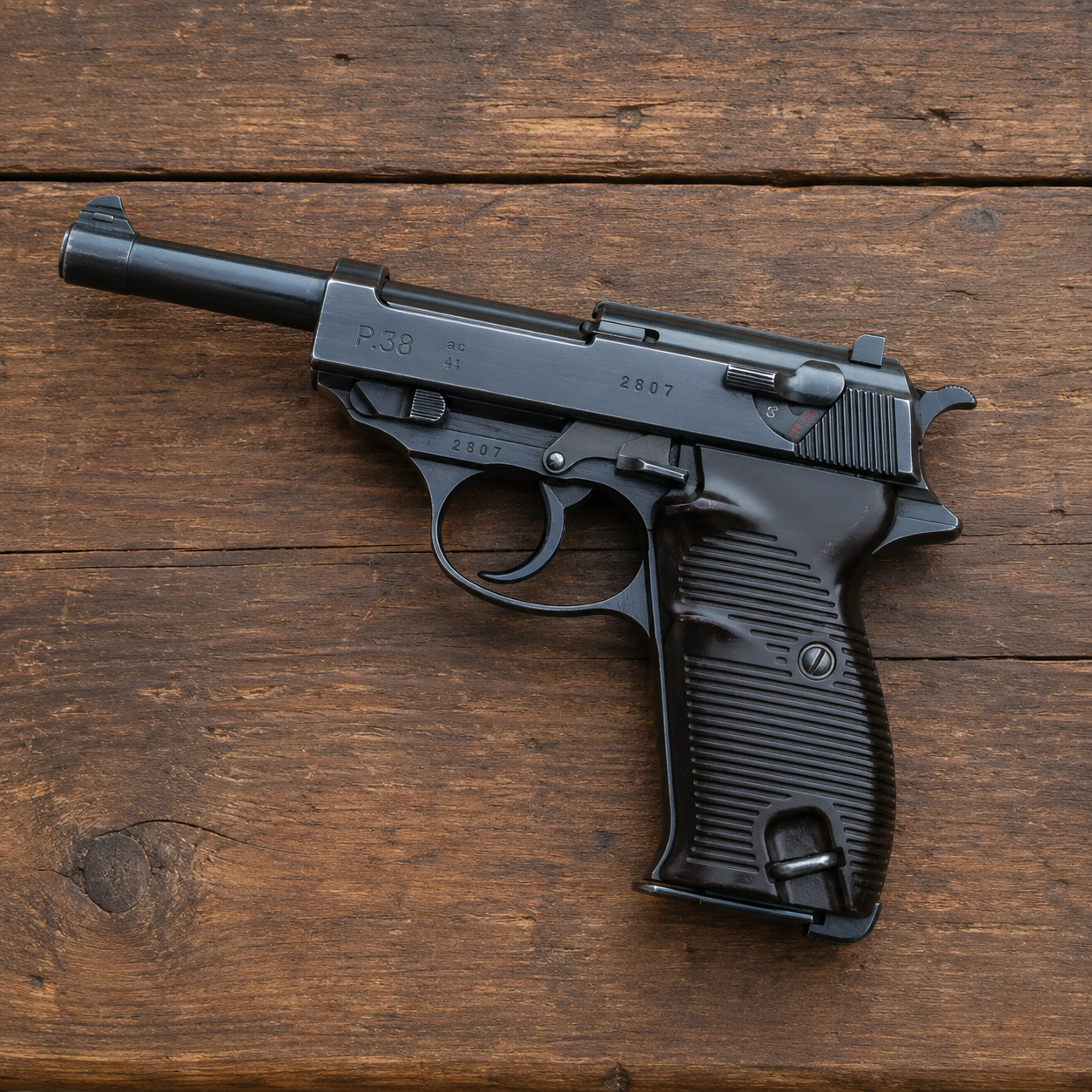
Designed in Germany in the 1930s, the Walther P38 was born as a response to the needs of the new army of the Third Reich. In 1938 it officially appeared under the name Armee Pistole and soon became one of the most influential pistols of the 20th century. Although at first it was conceived with a concealed hammer, the army demanded a redesign incorporating an external hammer, more practical in combat.
The P38 was pioneering in many ways. It was the first military pistol with a double-action system: it allowed a cartridge to be carried in the chamber, the hammer to be safely lowered, and the gun to fire directly by simply pulling the trigger, without the need to cock it first. This mechanism became the standard in many later modern weapons such as the Beretta 92.
Chambered for 9×19mm Parabellum cartridges, the P38 offered a muzzle velocity of 320 m/s, with an effective range of about 50 meters. It measured 216 mm in length, with a 125 mm barrel, and was fed by an eight-round magazine. The locking mechanism and barrel design —which followed a straight-line movement— provided good accuracy. The first versions incorporated walnut grips, later replaced by Bakelite, cheaper and easier for mass production.
On the industrial side, production began in earnest in 1940. Walther manufactured three initial trial series before moving to military production under the code “480.” Later, the designation “ac” was used. During the war years more than one million units were produced by Walther, Mauser, and other firms, maintaining notable internal quality even when the exterior finish was simplified for logistical reasons.
Postwar and evolution
After the end of World War II, the P38 continued in service, this time with the new army of West Germany (Bundeswehr). In 1957, under the designation P1, Walther resumed production, introducing a lighter aluminum-alloy frame. This new generation of pistols retained the general structure of the original model, though reinforced with a visible screw in front of the trigger guard. The P1 model remained in use until the early 1990s, when it was finally replaced by the Walther P8.
Special variants were also developed, such as the P4, with a shorter barrel and modified safety mechanism, used by police forces in several federal states.
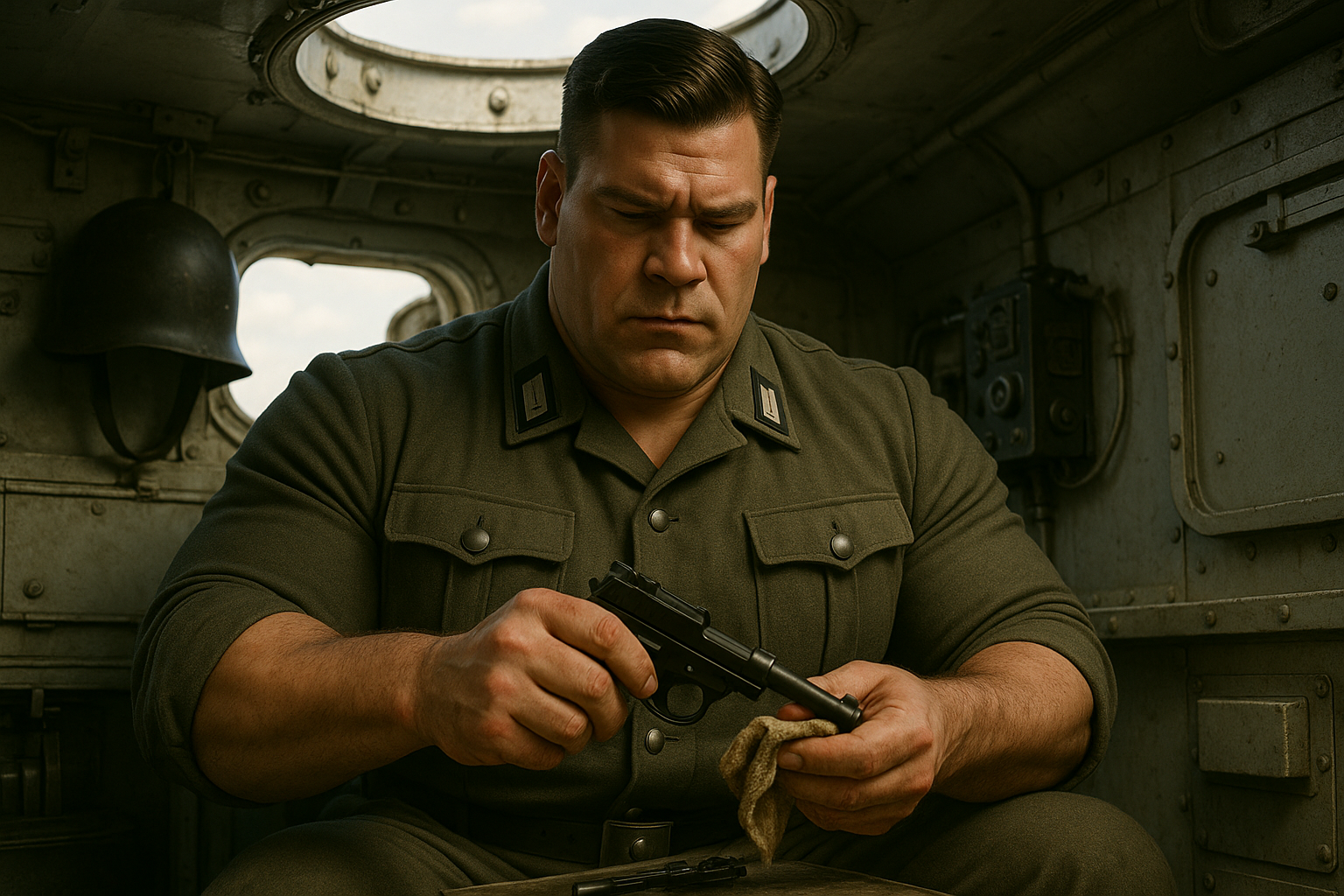
Cat and Mouse
Chapter 8
…Do you know what attitude is required of a chicken when it’s put in the oven? —asked Erich from his driver’s seat.
—That it do nothing more than just sit in there all warm and cozy —answered Enériz, while cleaning his Walther P-38 pistol…
Did you know…?
🔹Although it was created for the German army, the Walther P38 became a coveted collectible piece among Allied soldiers, thanks to its elegant design and accuracy. Its fame transcended into film and popular culture: it is the weapon into which Megatron transforms in Transformers and the favorite of Lupin III. Versions were also tested in calibers such as .45 ACP or .22 LR, though they never reached production. In cinema, it stands out in Dirty Harry (1971), used by the villain Scorpio in an iconic scene.

 EN
EN  ES
ES  FR
FR