Bolero

Una mecánica de la emoción
Maurice Ravel was born on March 7, 1875, in Ciboure, France, and died on December 28, 1937, in Paris.
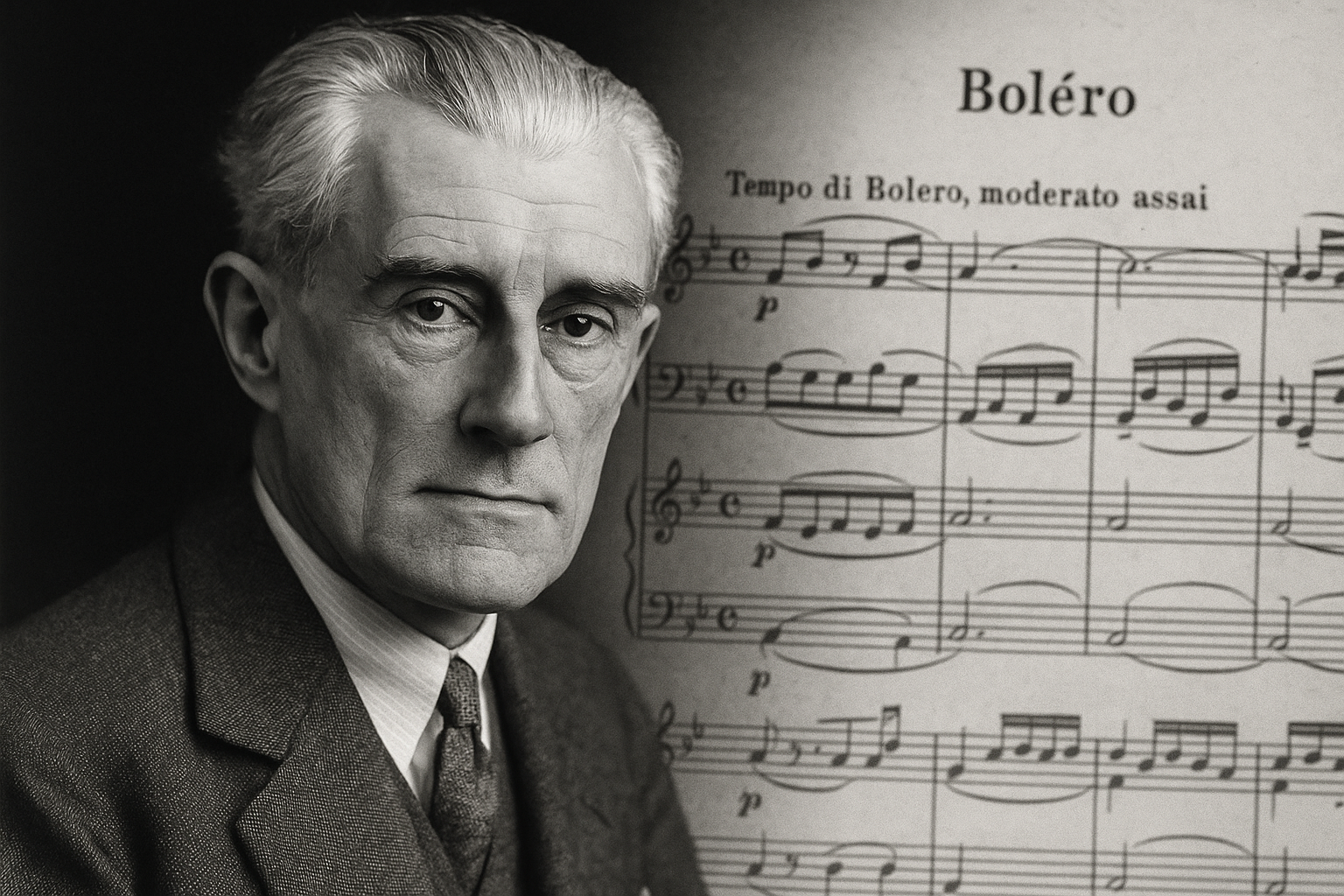
In 1928, Maurice Ravel was already showing the first signs of a progressive brain disease that affected his motor coordination and his linguistic ability. Despite these physical difficulties, his mind remained lucid and creative. It was then that he decided to compose a work that would break with the traditional symphonic form: a sonic experiment based on constant repetition.
The result was Bolero, a piece built on a single theme repeated hypnotically, without melodic development, only through variations in orchestration and dynamics. Its structure is deliberately mechanical, almost immutable, but it manages to generate a growing tension that culminates in overwhelming emotional intensity. Each repetition feels different, closer to the climax, even though the musical material barely changes.
Ravel openly acknowledged that it was not a true Spanish bolero, but, as he himself defined it, “a single long melody.” Even so, the work was an immediate success after its premiere, and it became one of the most emblematic compositions of the 20th-century orchestral repertoire.
Curiously, Ravel did not expect such enthusiasm. In his own words, he considered Bolero “a piece without music,” more a rhythmic experience than a melodic one. Nevertheless, its impact was such that even he was surprised by the intensity with which the audience connected to his proposal.
Since then, Bolero has been performed and adapted in multiple contexts, and its uninterrupted crescendo continues to fascinate both musicians and listeners. It is, ultimately, a work that demonstrates that emotion can arise not from change, but from insistence.
The Voyage
Chapter 21
…—Now I know how Ravel must have felt on the day of the premiere! —exclaimed Erich, smiling, amid uncontrolled ovations, tears of joy, and goosebumps…
Bolero
Did you know…?
🔹Bolero was composed by Ravel on commission from Ida Rubinstein, a Russian dancer and prominent figure in the Parisian artistic scene. She wanted music of great impact for a sensual and hypnotic ballet that she herself would perform. The premiere, choreographed by Bronislava Nijinska, was an immediate success. Rubinstein, after a life devoted to art, died in Paris in 1960, already retired from the stage.
Musical legacy today
The work of Maurice Ravel encompasses nearly forty essential compositions that include piano pieces, chamber music, vocal works, ballets, and orchestral scores. Among his most recognized titles are Daphnis et Chloé, Rapsodie espagnole, Ma mère l’Oye, Le tombeau de Couperin, and the Piano Concerto in G major. Within this repertoire, Bolero has become a universal emblem of his style: it is performed regularly in concert halls around the world, is a staple of numerous symphony orchestras’ repertoire, and continues to inspire new choreographies, stage versions, and contemporary adaptations. Its progressive structure has consecrated it as a reference model both in classical music and in other artistic genres. Today, Ravel’s music maintains a strong presence in festivals, concert series, and recordings, ensuring its relevance and confirming his place as one of the most influential voices of 20th-century music.

 EN
EN  ES
ES  FR
FR