SS Schutzstaffel Dagger

Historia de una pieza reglamentaria
Introduced in December 1933, the SS dagger was issued to all members of the organization, regardless of rank. Its design, inspired by 16th-century Swiss Holbein daggers, also evoked the silhouette of the Roman gladius, a nod to the idea of continuity between imperial past and contemporary mission.
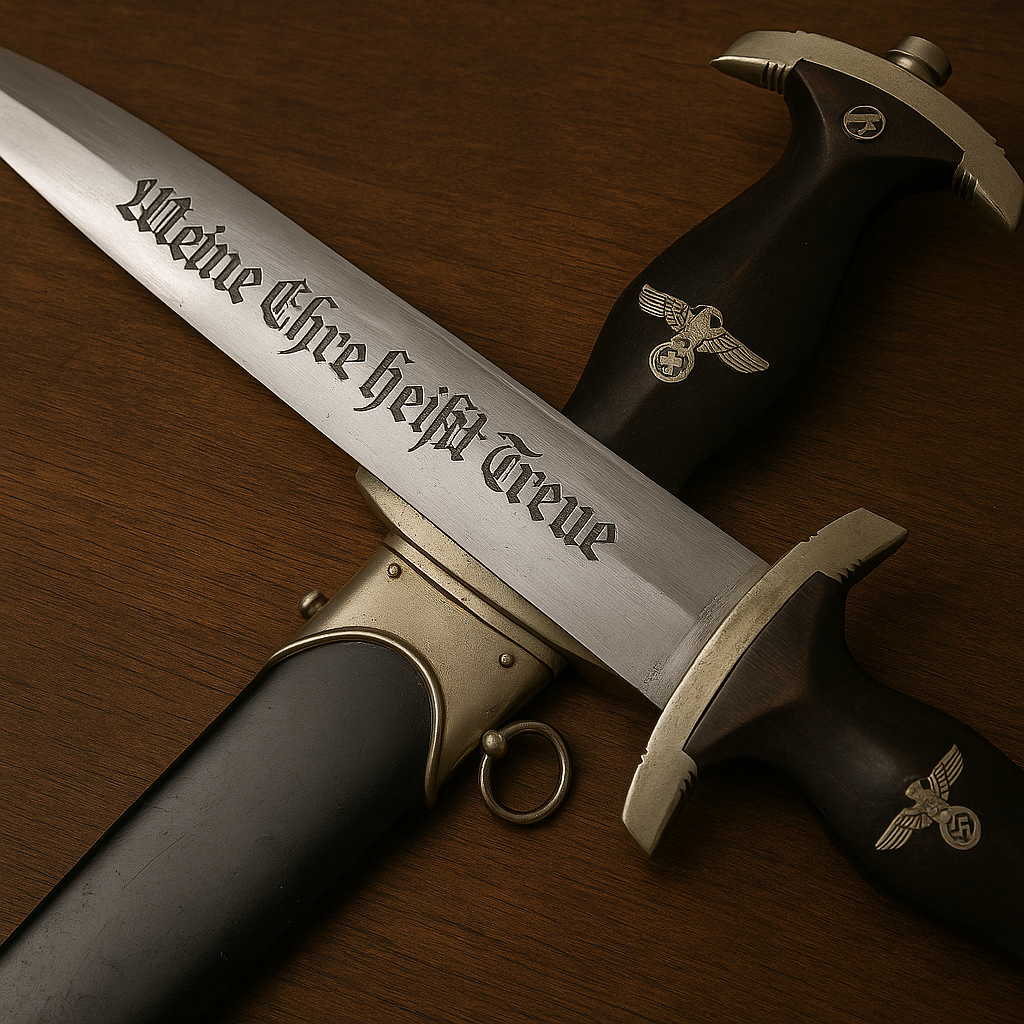
La daga SS presentaba una hoja de acero pulido con acabado tipo Damasco, donde se grababa el lema “Meine Ehre heißt Treue” (“Mi honor se llama lealtad”) en caligrafía gótica. Esta hoja, de 22 centímetros, se unía a una empuñadura de ébano ennegrecido mediante pigmentación vegetal. Incrustadas en ella, destacaban las runas “SS” en un pequeño medallón metálico y, más abajo, una águila imperial con las alas desplegadas, símbolo del poder estatal.
The blade was housed in a black-anodized steel scabbard, coated with protective lacquer and finished with nickel fittings, including a reinforced throat for the suspension ring and a spherical tip. The ensemble was completed with a curved nickel crossguard, decorated with hand-engraved grooves.
On some examples, the lower guard bears a Roman numeral (I, II, or III) indicating the city of issue —Munich, Berlin, or Dresden— which today helps trace their provenance. For regulation wear, a black leather strap with a nickel buckle was used, designed to be attached firmly and discreetly to the belt.
The dagger was not simply an ornamental object. It was considered an extension of the oath of loyalty, presented to SS members in a nighttime ceremony each November 9 in front of Munich’s Feldherrnhalle. The date, coinciding with the anniversary of the 1923 Putsch, made the presentation an act charged with ideology, illuminated by torches and marked by ritual silence.
Losing it entailed sanctions. From 1935, those expelled from the organization had to return it, although retirees could keep theirs with an official certificate. Some members, especially officers, commissioned personalized engravings or luxury versions with grips made from noble materials such as ivory or silver.
Production officially ceased in 1942. Over time, these daggers moved from the institutional sphere to the world of collecting, where today they are valued for their design, rarity, and craftsmanship more than for their symbolic weight.
The origin of the motto: “Meine Ehre heißt Treue”
The phrase dates back to 1931, during the conflict between the Berlin SA and the SS. Amid an attempted insubordination by Walter Stennes, only a small group of men led by Kurt Daluege stood firm in defense of the party while others abandoned their posts. Hitler, impressed by their loyalty, personally wrote Daluege a letter of congratulations, in which the phrase appeared for the first time:
“SS-Mann, deine Ehre heißt Treue.”
(SS man, your honor is called loyalty.)
Shortly afterward, it became the official motto of the organization and was engraved on every blade.

Contact
Chapter 10
…—Here you are no longer my superior. There’s no way I’m giving him my SS honor dagger,” Dietrich clarified.
—You’re not giving it away, it’s an exchange, flesh for the dagger…
Did you know…?
🔹Although the motto “Meine Ehre heißt Treue” is the best known, some daggers manufactured in 1934 show unique calligraphic variations that today allow collectors to identify very early runs, prior to engraving standardization.
🔹During the first months of production, before the official Gothic Fraktur typeface was standardized, some factories used different scripts, including:
🔹Sütterlin typeface: a German handwritten script, more fluid and less angular, found partially on some early daggers.
🔹Fraktur with wider or irregular strokes: especially on those produced by Eickhorn, Klaas, or Böker, before precise engraving guidelines were established.
🔹Slightly slanted letters or ornamental serifs, something corrected from 1935 onward, when quality control became stricter under Himmler’s orders.
🔹These calligraphic variants significantly increase collectible value, as they indicate early, limited production—often prior to the introduction of the mandatory serial number on the lower guard.

 EN
EN  ES
ES  FR
FR