Gestapo

Anatomía del Terror Nazi
The Gestapo, short for Geheime Staatspolizei (Secret State Police), was the official secret police of the Third Reich, operating in Germany and the occupied territories. Founded by Hermann Göring in 1933 by centralizing the Prussian security agencies, it came under Heinrich Himmler’s control in 1934 and was integrated into the SS structure.
In 1939, the Gestapo became Department IV (Amt IV) of the Reich Main Security Office (RSHA), directed by Reinhard Heydrich. Its operational chief was Heinrich Müller. From 1936 onward, it operated without judicial oversight, legally empowered to arrest, interrogate, torture, and eliminate opponents without trial, under the doctrine of Schutzhaft (“protective custody”), placing it above the legal system.
The Gestapo played a central role in political repression, the persecution of Jews, and the mass deportations during the Holocaust. Under Adolf Eichmann, Subdepartment IV B4 coordinated the “Final Solution.”
After the purge of the SA in 1934 during the “Night of the Long Knives,” the Gestapo, now under Himmler and Heydrich, consolidated its power. In 1936, Hitler unified all police forces under Himmler, who also created the Sicherheitsdienst (SD) and the Sicherheitspolizei (SiPo), combining the Gestapo with the Kriminalpolizei (Kripo).
The Gestapo’s structure was complex, organized into departments by subject (political opponents, churches, Jewish affairs, internal security, occupied territories, etc.). Locally, Gestapo offices reported to the Inspectors of the Security Police and the SD.
Although many members were young professionals with academic training, their methods were brutal, and their effectiveness lay in their network of informants and the systematic use of fear. The Gestapo was declared a criminal organization at the Nuremberg Trials.

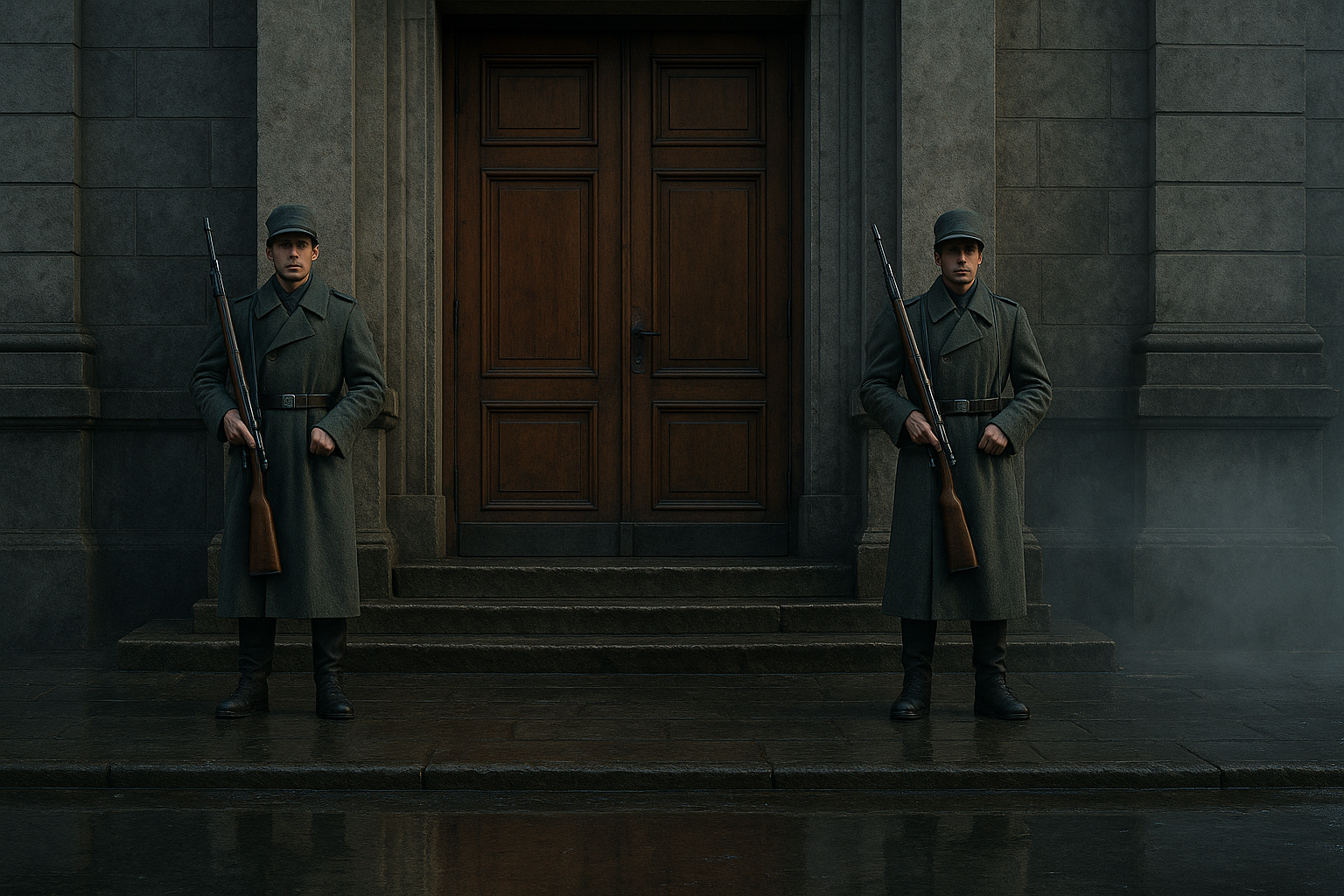
Gestapo Headquarters
Chapter 1
…It was nine in the morning. It had rained throughout the night. The sky was still overcast and the cold was glacial. SS-Oberschütze August and Carsen stood guard at the entrance of number eight Prinz-Albrecht-Strasse, the most feared building in all of Berlin…
Did you know…?
🔹The Gestapo’s central headquarters was at Prinz-Albrecht-Strasse 8, Berlin, a building that also housed SS and SD offices. From there, much of the Third Reich’s repressive apparatus was coordinated. Today, the same site hosts the Topography of Terror memorial.
🔹Although associated with police brutality, the Gestapo operated with a relatively small staff: in many cities, its effectiveness depended more on voluntary collaboration by citizens (denunciation) than on direct presence.
🔹Heinrich Müller, head of the Gestapo, disappeared in 1945 and was never captured or tried. His fate remains a mystery.
Intermediate cadres of the Gestapo
In addition to figures such as Heinrich Müller (operational chief) and Adolf Eichmann (head of Section IV B4, in charge of the “Final Solution”), the Gestapo also relied on other mid-ranking officers who played key roles in repression. Among them was Kriminalrat Kramer, a direct subordinate of Himmler, responsible for internal operations and the supervision of political arrests. Intelligent and ruthless, he embodied the cold bureaucratic efficiency that turned the Gestapo into an instrument of terror.
As with Müller, Kramer tras la caída del Reich permanece rodeado de misterio. Desapareció sin dejar rastro, alimentando la sospecha de que su ausencia fue deliberadamente ocultada entre los secretos más oscuros del régimen nazi.

 EN
EN  ES
ES  FR
FR