The White Rose

Young Germans Against Nazism
It was a group of passive resistance founded in June 1942 by students Hans Scholl and Alexander Schmorell at the University of Munich. Its objective: to denounce the crimes of Nazism and appeal to the moral conscience of Germans. To achieve this, they wrote, printed, and clandestinely distributed anti-Nazi leaflets throughout Bavaria and later in other cities in southern Germany.
From mid-1942, the group published six leaflets denouncing genocide, totalitarianism, the suppression of freedoms, and the need to oppose the regime. After the German defeat at Stalingrad, they also began painting slogans such as “Down with Hitler” and “Freedom” on Munich’s walls during nighttime actions.
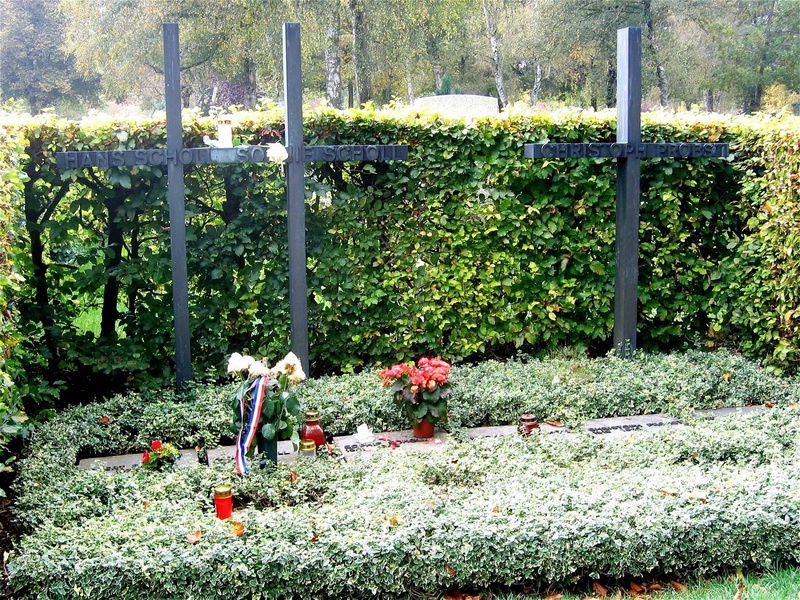
On February 18, 1943, Hans and Sophie Scholl were caught throwing leaflets inside the university. They were arrested after being denounced by a Nazi janitor and handed over to the Gestapo. Four days later, on February 22, they were tried and executed by guillotine along with Christoph Probst in Stadelheim Prison.
Main members
- Hans Scholl – medical student, cofounder of the group.
- Sophie Scholl – biology and philosophy student, Hans’s sister.
- Alexander Schmorell – Russian-German student, coauthor of the leaflets.
- Willi Graf – medical student, joined after fighting on the front.
- Christoph Probst – student, father of three children.
- Kurt Huber – professor of philosophy and musicology, author of the sixth leaflet.
Reprisals and legacy
After the first arrests, a second wave of detentions followed. Kurt Huber, Alexander Schmorell, and Willi Graf were executed in July and October 1943. Other members and collaborators were imprisoned or deported. Hans Leipelt and Marie-Luise Jahn were arrested for helping Huber’s widow; Leipelt was guillotined in 1945.
After the executions and arrests of 1943, the core of the White Rose seemed to have been completely dismantled. However, some scattered cells continued to operate in secret. Among those who kept the flame of resistance alive was Hans Frobë, an opponent who served as a link with sympathizers in Berlin and recruited Dr. Henke in the Nikolaikirche.
Brief biographies of the members
Hans Scholl
Born September 22, 1918, in Ingersheim. Medical student, cofounder of the White Rose. Along with his sister Sophie and Christoph Probst, he was executed by guillotine on February 22, 1943. He was 24 years old.
Sophie Scholl
Born May 9, 1921. Student of biology and philosophy. Arrested after throwing leaflets at the university. She died the same day as her brother. Her last words were: “The sun still shines.”
Alexander Schmorell
Born in Russia on September 16, 1917. Bilingual, Catholic, soldier on the Eastern Front. Coauthor of the first leaflets. Arrested after attempting to flee, he was executed on July 13, 1943.
Christoph Probst
Born November 6, 1919. Medical student and father of three children. Executed along with the Scholls on February 22, 1943. He was only 23 years old.
Willi Graf
Born January 2, 1918. Catholic, arrested with his sister. He endured months of interrogations and torture without betraying anyone. Executed on October 12, 1943.
Kurt Huber
Born October 25, 1893. University professor, author of the last leaflets. He refused to cooperate with the Nazi regime. Guillotined on July 13, 1943.
Memory
The graves of several members are located in the Perlacher Forst Cemetery in Munich. Today, streets and schools across Germany bear their names:
- Geschwister-Scholl-Straße (Scholl Siblings Street)
- Alexander-Schmorell-Straße, Willi-Graf-Gymnasium, etc.
The silence of Carl Orff
When Kurt Huber’s wife asked composer Carl Orff to intercede to save him, he refused, fearing the ruin of his career. Years later, he sent a letter of apology to the widow.
Saint-Nicholas Church
Chapter 2
…Now nothing prevents me from continuing with the matter at hand. Well then, the fact is that I am a member of the «White Rose» movement, a resistance group that has been operating in Berlin since 1942. You knew its founder at the University of Munich, it was Hans Scholl…

Did you know…?
🔹The White Rose was neither a political nor a violent movement. It was a moral, ethical, and academic act in the very heart of the Third Reich.
🔹The Scholl siblings threw their last batch of leaflets in the atrium of their own university, in broad daylight, fully aware that the risk was extreme.
🔹Until the very end, none of the arrested members betrayed others. They all died with dignity, reaffirming their conscience and their inner freedom.
🔹Today, in Germany, there are streets, schools, and monuments that bear their names. The atrium of the University of Munich has commemorative plaques, and the leaflets are preserved as historical documents.
🔹Sophie Scholl was chosen in 2003 as the most important German woman of the 20th century in a national survey.
Sophie Scholl carried a copy of the sixth leaflet hidden in her coat when she was arrested. It was discovered by chance when one slipped down the stairs as she threw them.

The 6 Pamphlets
📄 First pamphlet (June 1942)
It criticizes the apathy of German society and demands an ethical reaction against Nazism.
📄 Second pamphlet (June 1942)
It openly denounces the exterminion of Jewish people in Poland and condemns the complicit silence.
📄 Third pamphlet (July 1942)
It calls for passive resistance and the direct sabotage of the Nazi war machine.
📄 Fourth pamphlet (July 1942)
It labels Hitler a satanic figure and states that the White Rose will never be silenced.
📄 Fifth pamphlet (January 1943)
It predicts Germany's military defeat and proposes a future federal, democratic Europe.
📄 Sixth pamphlet (February 1943)
It formally demands that university students rebel and lead the resistance.



 EN
EN  ES
ES  FR
FR